|
|
| Line 1: |
Line 1: |
| | {{infobox institution | | {{infobox institution |
| − | | name = Fergus Falls State Hospital | + | | name = Kankakee State Hospital |
| − | | image = Fergusfalls2.jpg | + | | image = Kankakee.png |
| | | image_size = 250px | | | image_size = 250px |
| − | | alt = Fergus Falls State Hospital | + | | alt = |
| | | caption = | | | caption = |
| − | | established = 1887 | + | | established = 1877 |
| − | | construction_began = 1888 | + | | construction_began = 1878 |
| − | | construction_ended = 1907 | + | | construction_ended = |
| − | | opened = July 29, 1890 | + | | opened = 1879 |
| − | | closed = 2007 | + | | closed = |
| | | demolished = | | | demolished = |
| − | | current_status = [[Closed Institution|Closed]] and [[Preserved Institution|Preserved]] | + | | current_status = [[Active Institution|Active]] |
| − | | building_style = [[Kirkbirde Planned Institutions|Kirkbride Plan]]
| + | | building_style = [[Cottage Planned Institutions|Cottage Plan]]<br> |
| − | | architect(s) = Warren B. Dunnell | + | [[Kirkbride Planned Institutions|Kirkbride Plan]] |
| − | | location = Fergus Falls, MN | + | | architect(s) = |
| − | | architecture_style = | + | | location = Kankakee, IL |
| − | | peak_patient_population = 2,078 in 1937 | + | | architecture_style = Romanesque |
| − | | alternate_names =<br> | + | | peak_patient_population = |
| − | *Third Minnesota State Hospital for the Insane | + | | alternate_names =<br> |
| − | *Fergus Falls Regional Treatment Center (RTC) | + | *Illinois Eastern Hospital for the Insane |
| | + | *Kankakee Developmental Center |
| | + | *Kankakee Mental Health Center |
| | + | *Governor Samuel H. Shapiro Development Center |
| | }} | | }} |
| | | | |
| − | ==History== | + | == History == |
| − | ====The following is from a 1916 report====
| + | On May 25, 1877, the Illinois Legislature approved the building of a new hospital to serve the eastern part of the state. The legislation directed Gov. Shelby Cullom to appoint a group of seven commissioners who would choose a location for the new institution. Selection of the commissioners involved regional rivalries and other political considerations; the final makeup of that group could be vital in determining which town would be chosen. Many cities offered inducements by way of donations, for the location of the new hospital but the site finally selected was a farm of 250 acres near Kankakee, and this was subsequently enlarged by the purchase of 327 additional acres in 1881. |
| − | In 1885, the two existing state hospitals for the insane of Minnesota being overcrowded with patients, it became necessary to take steps for the erection of a third institution. Consequently the Legislature of 1885 passed an act to establish a commission to locate a third hospital for the insane and prepare plans for its construction. This act authorized and required the Governor to appoint a commission to consist of five persons, who should locate a site for said hospital at some point in the northern part of the state, cause plans to be made, and present an estimate of the cost under said plans. The act was approved by the Governor, Lucius F. Hubbard, on March 2, and shortly afterwards he appointed R. B. Langdon, of Minneapolis; C. K. Bartlett, superintendent of the St. Peter Hospital; H. H. Hart, of St. Paul, secretary of the Board By G. O. Welch, M. D., superintendent of Corrections and Charities; H. G. Stordeck, of Breckenridge, and F. S. Christensen, of Rush City, as members of the commission. The commission looked over the various sites suggested and finally selected one in the northern part of the City of Fergus Falls. An estimate was prepared covering the cost of land and the erection of ward buildings for 300 patients, with boiler house, laundry, etc. The report and recommendations of the commission were laid before the Legislature of 1887 and that body passed an act locating and establishing a third hospital for the insane at the City of Fergus Falls and placing the institution under the charge and control of the Board of Trustees for the insane of Minnesota. Later in the session an appropriation of $24,280 was made for the purchase of 596 acres of land, and $70,000 for the buildings recommended by the commission.
| |
| | | | |
| − | As soon as it was known that a new institution for the insane was contemplated the homeopathic physicians of the state, believing that their school deserved some recognition, took active steps to secure the proposed hospital. As a result of their efforts the Legislature of 1887 passed the following act:
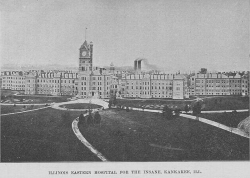
| + | Work was begun in 1878 and the first patients received in December 1879. the plan of the institution is, in many respects, unique. It comprises a general building three stories high capable of accommodating 300 to 400 patients and a number of detached buildings, technically termed cottages, where various classes of insane patients may be grouped and receive the particular treatment best adapted to ensure their recovery. The plans were mainly worked out from suggestions by Frederick Howard Wines, LL.D., then Secretary of the Board of Public Charities, and have attracted generally favorable comment both in this country and abroad. |
| | | | |
| − | That the superintendent and corps of physicians appointed for the third hospital for the insane, located at Fergus Falls, shall be of the school of homoeopathy, and the Board of Trustees of the hospitals for the insane of Minnesota are hereby directed to make appointments in accordance herewith as soon as the hospital is ready for patients.
| + | The seventy-five buildings occupied for the various purposes of the institution, cover a quarter section of land laid off in regular streets, beautified with trees, plants and flowers, and presenting all the appearance of a flourishing village with numerous small parks adorned with walks and drives. |
| | | | |
| − | Shortly after the Board of Trustees took control of the affairs of the new hospital Warren B. Dunnell, of Minneapolis, was appointed architect. During the fall of 1887 he visited many of the Eastern hospitals and on his return plans were prepared for the new institution, upon which work was begun in 1888. The ward buildings are of the congregate plan, with a main wing 430 feet long, and a detached wing 200 feet long for each sex. The buildings are three stories high, with a finished attic; they are built of cream brick with sandstone trimmings and a slate roof; are of fireproof construction, and are of pleasing and artistic appearance.
| + | The counties from which patients are received include: |
| | + | Cook, Champaign, Coles, Cumberland, De Witt, Douglas Edgar, Ford, Grundy, Iroquois, Kankakee, La Salle, Livingston, Macon, McLean, Moultrie, Piatt, Shelby, Vermilion and Will. The whole number of patients in 1898 was 2,200 while the employees of all classes numbered 500. |
| | | | |
| − | There was considerable delay in completing the first buildings contracted for, as the money appropriated was not sufficient for the purpose. The Legislature of 1889 made an additional appropriation of $65,000 and the first ward building was at length ready for occupancy. On July 29, 1890, the hospital was declared open and on the 30th 90 men were transferred thereto from the St. Peter State Hospital.
| + | For the first quarter-century of its existence, the hospital grew steadily in both physical facilities and patient population. The first patient was admitted on Dec. 4, 1879; by Jan. 1, 1880, the patient population was 33. The patient population had risen to 2,300 by 1903, with more than 700 people (including eight physicians) providing treatment and support services. By 1903, the original dozen or so buildings had increased to nearly 50. The large central clock tower building, with multi-story wings on each side, housed hundreds of patients as well as hospital offices and living quarters for physicians. Twenty-six large stone cottages provided housing for from 24 to 173 patients each; 15 housed male patients, and 11 were reserved for female patients. More than two dozen additional structures served various support functions and employee housing. |
| | | | |
| − | Since the opening of the hospital each succeeding Legislature, realizing the necessity of relieving the overcrowded condition of the other institutions for the insane, has been very generous in its appropriations. The ward buildings proper and all the outside buildings as contemplated in the original plans were completed in 1899. Since then the farm acreage has been largely increased, several new buildings have been erected, some of the older ones have been enlarged in order that they may be better adapted to the purposes for which they were intended, and many improvements have been made in various parts of the plant in order to bring it up to the highest state of efficiency.
| + | In 1975 the hospital became the center for care and treatment of the developmentally disabled and all other patients were moved elsewhere. The Kirkbride houses offices & a small number of elderly patients. |
| | | | |
| − | The total cost of the plant up to the present time has been approximately $1,252,000, divided as follows: Land (1075.61 acres), $51,365; ward buildings, $750,000; administration building, $57,000; kitchen and storeroom buildings, $91,000; heating and lighting plant, $90,000; barns and live stock, $30,500; laundry, $32,000; water supply, $12,000; nurses' home, $80,000; amusement hall and congregate dining room, $32,000; shops, $8500; library, $1000; subways, $5000; improvement of grounds, $4500; electric and surgical apparatus, $5000; fire alarm system, $2000.
| + | ===Note:=== |
| | + | This hospital started out planned as a Kirkbride, but was changed to a cottage plan while it was still being planned and built. It has been argued that this hospital was the first cottage plan to be built. Yet, some of the buildings on the campus do have building/ground styles that can be attributed to the Kirkbride plan. |
| | | | |
| − | In September, 1887, the Board of Trustees appointed Captain O. C. Chase, of Fergus Falls, as general overseer of the work. In February, 1890, Captain Chase was appointed to the position of steward, which office he has held since that time, having proved himself a faithful and efficient officer.
| |
| | | | |
| − | During the spring of 1890 the Board of Trustees selected Dr. Alonza P. Williamson as superintendent, and he took charge of the institution on the 4th of May. Dr. Williamson was a graduate of the Hahnemann Medical College of Philadelphia. After graduation he served for a time at Ward's Island, New York, and afterwards accepted a position at the Middletown State Hospital, New York, where he served for a number of years as assistant superintendent. Coming to the new hospital in Minnesota in its infancy, he was instrumental in establishing the work upon a solid foundation, to which much of its future success was due. Dr. Williamson resigned his position on November 9, 1892, and opened an office in Minneapolis, devoting himself to special work in mental and nervous diseases. On the day of his resignation Dr. George O. Welch was appointed superintendent. Dr. Welch was a native of Massachusetts and a graduate of the Boston University. In June, 1887, he was appointed to a position on the staff of the Westborough State Hospital of Massachusetts and resigned that position in February, 1892, to take a post-graduate course in mental and nervous diseases in Europe. While abroad he was appointed to the position of superintendent at the Fergus Falls State Hospital, which position he has held since that time.
| + | == Images of Kankakee State Hospital == |
| | + | {{image gallery|[[Kankakee State Hospital Image Gallery|Kankakee State Hospital]]}} |
| | | | |
| − | As soon as the institution was ready for patients the Board of Trustees divided the state into three hospital districts. The Fergus Falls district includes practically all of the state north of the City of Minneapolis, a much larger area than the other two districts combined, but not nearly so thickly populated. As the state is growing fast, the hospital is beginning to suffer from the usual overcrowded condition, having now (1912) a population of 1650 patients, with a normal capacity of 1500. Since the opening of the hospital over 8000 patients have been admitted. The results of treatment have been very satisfactory, a large proportion of the recently admitted cases being sent out each year in a normal mental condition.
| |
| − |
| |
| − | A training school for nurses was organized in 1894. The two years' course at first required by the school was later changed to three. The school has always been open to both sexes, but entrance therein has never been obligatory. Since the opening of the school 103 men and 114 women have been graduated. The school has helped materially to raise the standard of efficiency among the nursing force, and many of the graduates now hold responsible hospital positions elsewhere.
| |
| − |
| |
| − | The following named gentlemen served upon the Board of Trustees from the opening of the hospital until 1901, when all institutions were placed under the Board of Control: A. L. Sackett, J. F. Meagher, A. Barto, M. R. Tyler, C. D. Wright, A. T. Stebbins, Dr. J. F. Fulton, John Peterson, J. W. Mason, T. H. Titus, Dr. W. A. Jones, R. A. Smith, J. H. Block, Dr. C. L. Wells, T. D. O'Brien, Dr. D. N. Jones, Dr. A. W. Daniels, J. H. Wagoner, J. A. Coleman, John Heinen, C. J. Hanson.<ref>http://books.google.com/books?id=bnraAAAAMAAJ&printsec=frontcover&dq=editions:UOM39015005122398&client=firefox-a#v=onepage&q&f=false</ref>
| |
| − |
| |
| − | '''SUPERINTENDENTS'''
| |
| − | *Dr. Alonzo P. Williamson 1890-1892
| |
| − | *Dr. George O. Welch (in office) 1892
| |
| − |
| |
| − | '''ASSISTANT SUPERINTENDENTS'''
| |
| − | *Dr. A. S. Dolan 1890-1893 Dr. Franklin S. W1lcox.. 1904-1912
| |
| − | *Dr. G. R. Ball 1893-1895 Dr. Clarence C. Burling
| |
| − | *Dr. Wm. O. Mann 1895-1899 ton (in office) 1912
| |
| − | *Dr. Henry M. Pollock... 1899-1904
| |
| − |
| |
| − | '''ASSISTANT PHYSICIANS'''
| |
| − | *Dr. E. P. Taft 1891-1893 Dr. Ralph Deming 1914
| |
| − | *Dr. Hamilton Meade 1893-1895 Dr. W. L. Patterson
| |
| − | *Dr. W. D. Kirkpatrick. . 1895-1897 Dr. Emile Young 1893-1895
| |
| − | *Dr. H. H. Bingham 1895-1899 Dr. Addie F. F1tzpatrick
| |
| − | *Dr. Addie F. Gilman Dr. Bertha A. Hughes...
| |
| − | *Dr. G. H. Cobb Dr. Oskar L. Bertelson..
| |
| − | *Dr. Bertha A. Frost 1895- Dr. Jennie G. Erdman...
| |
| − | *Dr. L. A. Williams 1897- Dr. DeEtte Brownell...
| |
| − | *Dr. Edwin Waite 1900- Dr. Bertha G. Dressner..
| |
| − | *Dr. J. B. Brown 1900-1901 Dr. Cora M. Johnson
| |
| − | *Dr. N. F. Doleman Dr. Olive E. Smith
| |
| − | *Dr. T. M. Thayer Dr. A. W. Ogden (in of
| |
| − | *Dr. F. R. Sedgley fice) 1912
| |
| − | *Dr. I. H. Kiesling Dr. C. M. Jared (in of
| |
| − | *Dr. L. R. Clapp fice) 1914
| |
| − | *Dr. J. F. Lovell
| |
| − |
| |
| − | '''STEWARD'''
| |
| − | *O. C. Chase (in office) 1889-<ref>http://books.google.com/books?id=bnraAAAAMAAJ&printsec=frontcover&dq=editions:UOM39015005122398&client=firefox-a#v=onepage&q&f=false</ref>
| |
| − |
| |
| − | ====20th & 21st Century====
| |
| − | The institution served 17 counties in northwestern and west central Minnesota with the patient census reaching an all-time high of 2,078 in 1937. The regional treatment center was one of the first multipurpose campuses, serving those with developmental disabilities, chemical dependency as well as psychiatric illnesses.<ref>http://discussions.mnhs.org/collections/2008/03/fergus-falls-state-hospital-papers/</ref> The kirkbride building was placed on the National Register of Historic Places in 1986.<ref>http://www.fergusphotos.com/rtc/#History</ref> During the 1980s, 90s, and into 2000 the hospital population decreased as patients were placed in smaller community based facilities. In 2007 the campus buildings were sold to the City of Fergus Falls.<ref>http://discussions.mnhs.org/collections/2008/03/fergus-falls-state-hospital-papers/</ref> In 2009 a lighting strike on the administration section cause a fire to break out in the center steeple. Fire crews responded and prevented the fire from spreading further down into the admin but were criticized by some for their slow response time.<ref>http://www.kirkbridebuildings.com/blog/fergus-falls-fire</ref> The city has since placed a "cap" on top of the steeple. On August 30th, 2010 the city listed the former hospital campus for sale on Craigslist for $1. The ad stated that any potential buyers must have "a plan for development and proof of private development capital".<ref>http://www.kirkbridebuildings.com/blog/a-kirkbride-on-craiglist</ref> In the first half of 2011 the city of Fergus Falls proposed a phased demolition of many of the non-historical structures. In the initial version of this plan the Kirkbride building would not be demolished, only the cafeteria, gymnasium, administrative building, and some other outbuildings behind the Kirkbride, as well as several tunnels connecting the buildings would be demolished. The demolition plan has a tentative start date of summer 2012 unless a developer steps in and purchases the property.<ref>http://www.fergusfallsjournal.com/2011/05/03/kirkbride-building-could-have-one-last-chance/</ref>
| |
| − |
| |
| − |
| |
| − | == Images of Fergus Falls State Hospital ==
| |
| − | {{image gallery|[[Fergus Falls State Hospital Image Gallery|Fergus Falls State Hospital]]}}
| |
| | <gallery> | | <gallery> |
| − | File:Fergusfalls4.jpg
| + | file:084a.jpg |
| − | File:Fergusfallsmn.jpg
| + | file:Kankakee01.png |
| − | File:Pf070862.jpg | + | file:003a.jpg |
| − | File:Pf032358.jpg | + | file:Kankakee6.png |
| | + | File:15689582850 368171585e_z.jpg |
| | + | File:kankakeeIL008.jpg |
| | </gallery> | | </gallery> |
| | | | |
| − | | + | ==Video== |
| − | ==Videos== | |
| | * Video from Kirkbrides HD ~ http://www.vimeo.com/channels/KirkbridesHD | | * Video from Kirkbrides HD ~ http://www.vimeo.com/channels/KirkbridesHD |
| | | | |
| − | * http://www.vimeo.com/kirkbrideshd/fergusfalls | + | * http://www.vimeo.com/kirkbrideshd/kankakee |
| | | | |
| − | <videoflash type="vimeo">30770325</videoflash> | + | <videoflash>rauwH8Guhf0</videoflash> |
| − | <BR>
| |
| − | <BR>
| |
| − | *A video clip of the 2009 fire caused by a lightning strike on the admin. (PART 1)
| |
| − | <videoflash>IRWF4XAmlXI</videoflash>
| |
| − | <BR>
| |
| − | *A video clip of the 2009 fire caused by a lightning strike on the admin. (PART 2)
| |
| − | <videoflash>y-orG0B7Oeo</videoflash>
| |
| | | | |
| − | == Links and Additional Information== | + | ==Cemetery== |
| − | *[http://www.kirkbridebuildings.com/buildings/fergusfalls/ Fergus Falls State Hospital @ Kirkbride Buildings]
| + | Located next to the Kankakee Community College, which used to be part of the hospital farm. The cemetery contains 1,500-2,000 graves of patients. |
| − | *[http://nrhp.mnhs.org/property_overview.cfm?propertyID=18 Minnesota Historical Society]
| |
| − | *[http://news.minnesota.publicradio.org/features/2004/07/30_gundersond_ffrtc/ An article on how the city is trying to save the hospital]
| |
| − | *[http://www.kirkbridebuildings.com/forum/viewtopic.php?f=34&t=597 Photos of the hospital]
| |
| − | *[http://www.kirkbridebuildings.com/blog/fergus-falls-fire Info on the 2009 Admin fire]
| |
| − | *[http://nrhp.mnhs.org/property_overview.cfm?propertyID=18 Minnesota Historical Society Entry]
| |
| − | *[http://theemptyplaces.com/wordpress/institutions/minnesota/fergus-falls-state-hospital/ Additional Photos]
| |
| − | *[http://www.facebook.com/groups/146744348673366/ Friends of the Kirkbride - Preservation Group]
| |
| − | *[http://www.fergusfallsjournal.com/2011/05/03/kirkbride-building-could-have-one-last-chance/ City gives Kirkbride one last chance]
| |
| − | *[[Special:AWCforum/st/id597|Project Kirkbride]]
| |
| | | | |
| − | == References == | + | == Links & Additional Information == |
| − | <references/>
| + | [http://www3.gendisasters.com/illinois/10988/kankakee-il-insane-hospital-fire-jan-1885 An article on the 1885 fire] |
| | | | |
| | + | The Architecture of Madness-Insane Asylums in the United States, Yanni, Carla, University of Minnesota Press (2007) |
| | | | |
| − | [[Category:Minnesota]] | + | [[Category:Illinois]] |
| | + | [[Category:Active Institution]] |
| | + | [[Category:Cottage Plan]] |
| | [[Category:Kirkbride Buildings]] | | [[Category:Kirkbride Buildings]] |
| − | [[Category:Closed Institution]]
| |
| − | [[Category:Preserved Institution]]
| |
| − | [[Category:Articles With Videos]]
| |
| | [[Category:Institution With A Cemetery]] | | [[Category:Institution With A Cemetery]] |
| | [[Category:Past Featured Article Of The Week]] | | [[Category:Past Featured Article Of The Week]] |
| | + | [[Category:Articles With Videos]] |
| Kankakee State Hospital |
|---|
 |
| Established |
1877 |
|---|
| Construction Began |
1878 |
|---|
| Opened |
1879 |
|---|
| Current Status |
Active |
|---|
| Building Style |
Cottage Plan
Kirkbride Plan |
|---|
| Location |
Kankakee, IL |
|---|
| Architecture Style |
Romanesque |
|---|
| Alternate Names |
- Illinois Eastern Hospital for the Insane
- Kankakee Developmental Center
- Kankakee Mental Health Center
- Governor Samuel H. Shapiro Development Center
|
|---|
History
On May 25, 1877, the Illinois Legislature approved the building of a new hospital to serve the eastern part of the state. The legislation directed Gov. Shelby Cullom to appoint a group of seven commissioners who would choose a location for the new institution. Selection of the commissioners involved regional rivalries and other political considerations; the final makeup of that group could be vital in determining which town would be chosen. Many cities offered inducements by way of donations, for the location of the new hospital but the site finally selected was a farm of 250 acres near Kankakee, and this was subsequently enlarged by the purchase of 327 additional acres in 1881.
Work was begun in 1878 and the first patients received in December 1879. the plan of the institution is, in many respects, unique. It comprises a general building three stories high capable of accommodating 300 to 400 patients and a number of detached buildings, technically termed cottages, where various classes of insane patients may be grouped and receive the particular treatment best adapted to ensure their recovery. The plans were mainly worked out from suggestions by Frederick Howard Wines, LL.D., then Secretary of the Board of Public Charities, and have attracted generally favorable comment both in this country and abroad.
The seventy-five buildings occupied for the various purposes of the institution, cover a quarter section of land laid off in regular streets, beautified with trees, plants and flowers, and presenting all the appearance of a flourishing village with numerous small parks adorned with walks and drives.
The counties from which patients are received include:
Cook, Champaign, Coles, Cumberland, De Witt, Douglas Edgar, Ford, Grundy, Iroquois, Kankakee, La Salle, Livingston, Macon, McLean, Moultrie, Piatt, Shelby, Vermilion and Will. The whole number of patients in 1898 was 2,200 while the employees of all classes numbered 500.
For the first quarter-century of its existence, the hospital grew steadily in both physical facilities and patient population. The first patient was admitted on Dec. 4, 1879; by Jan. 1, 1880, the patient population was 33. The patient population had risen to 2,300 by 1903, with more than 700 people (including eight physicians) providing treatment and support services. By 1903, the original dozen or so buildings had increased to nearly 50. The large central clock tower building, with multi-story wings on each side, housed hundreds of patients as well as hospital offices and living quarters for physicians. Twenty-six large stone cottages provided housing for from 24 to 173 patients each; 15 housed male patients, and 11 were reserved for female patients. More than two dozen additional structures served various support functions and employee housing.
In 1975 the hospital became the center for care and treatment of the developmentally disabled and all other patients were moved elsewhere. The Kirkbride houses offices & a small number of elderly patients.
Note:
This hospital started out planned as a Kirkbride, but was changed to a cottage plan while it was still being planned and built. It has been argued that this hospital was the first cottage plan to be built. Yet, some of the buildings on the campus do have building/ground styles that can be attributed to the Kirkbride plan.
Images of Kankakee State Hospital
Main Image Gallery: Kankakee State Hospital
Video
<videoflash>rauwH8Guhf0</videoflash>
Cemetery
Located next to the Kankakee Community College, which used to be part of the hospital farm. The cemetery contains 1,500-2,000 graves of patients.
Links & Additional Information
An article on the 1885 fire
The Architecture of Madness-Insane Asylums in the United States, Yanni, Carla, University of Minnesota Press (2007)


